
Parents ask me this all the time: my child still leans on pinyin to read Chinese — how do I get them off it? My answer is an old Chinese saying — 过河拆桥, “cross the river, then take down the bridge.”
Pinyin is the bridge. Its whole job is to carry a child across to the character. Once they’ve crossed — once the character is truly theirs — the bridge can come down. The mistake is trying to knock the bridge away before the child has made it across.
How it works in class
When a student meets a new text, we don’t begin by reading it. We begin with the words. First we learn the new characters and vocabulary; then we work through the text together until they understand it; and only as the very last step do they read it aloud, without pinyin. By then the pinyin isn’t holding them up — they’ve already made friends with the words.
You can do the same at home
Learn the words first and understand the text, then save reading-without-pinyin for last. Don’t strip all the pinyin away at once — let it thin out text by text, as your child’s bank of characters grows. Keep pinyin for the genuinely new words, and let them read the characters they already know on their own.
What it looks like over the years
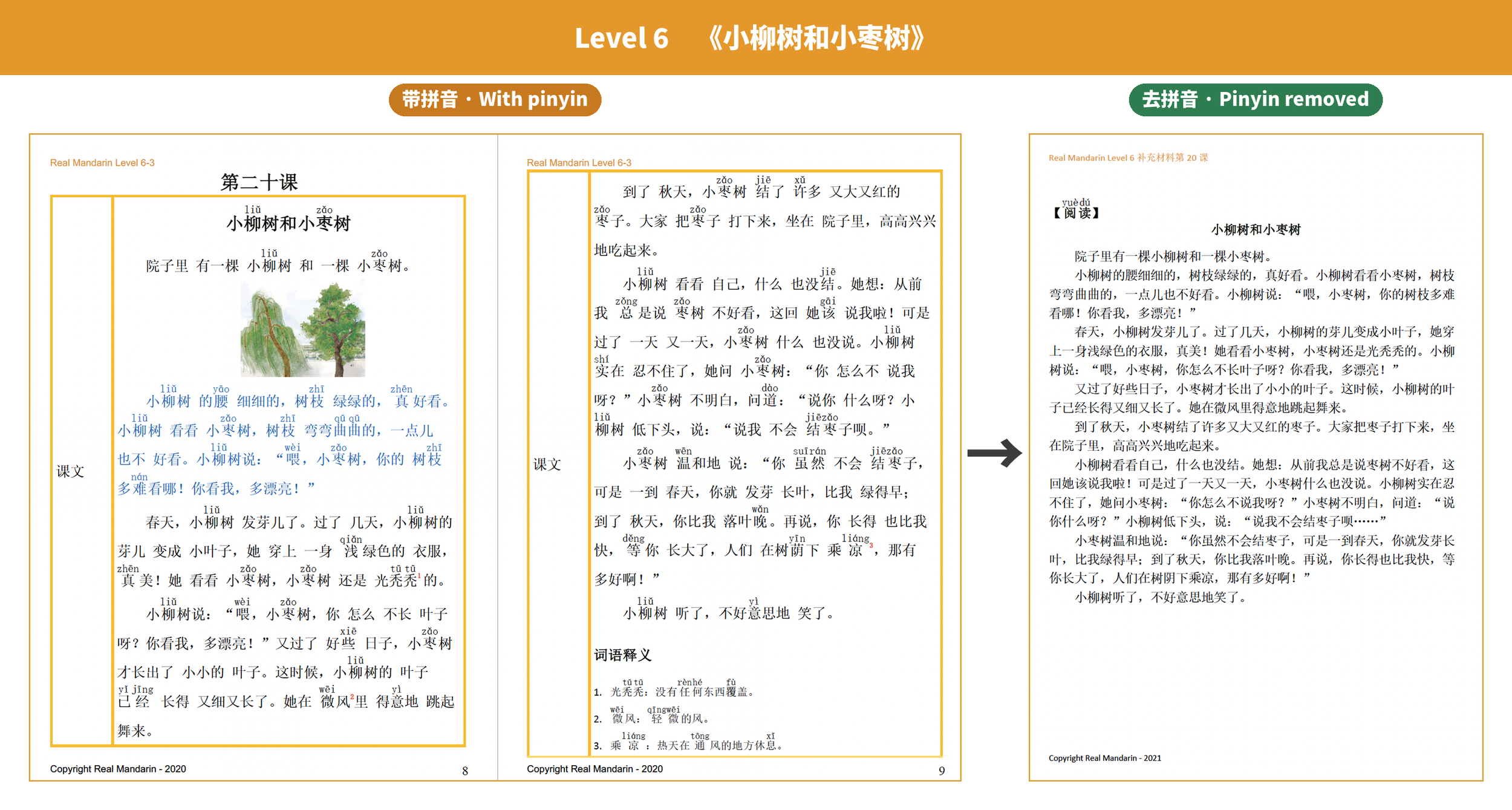
At Level 6, the story 小柳树和小枣树 arrives with pinyin over almost every character. Once the words are learned, the same story comes back with the pinyin gone — and the child reads it, because the characters are now familiar.
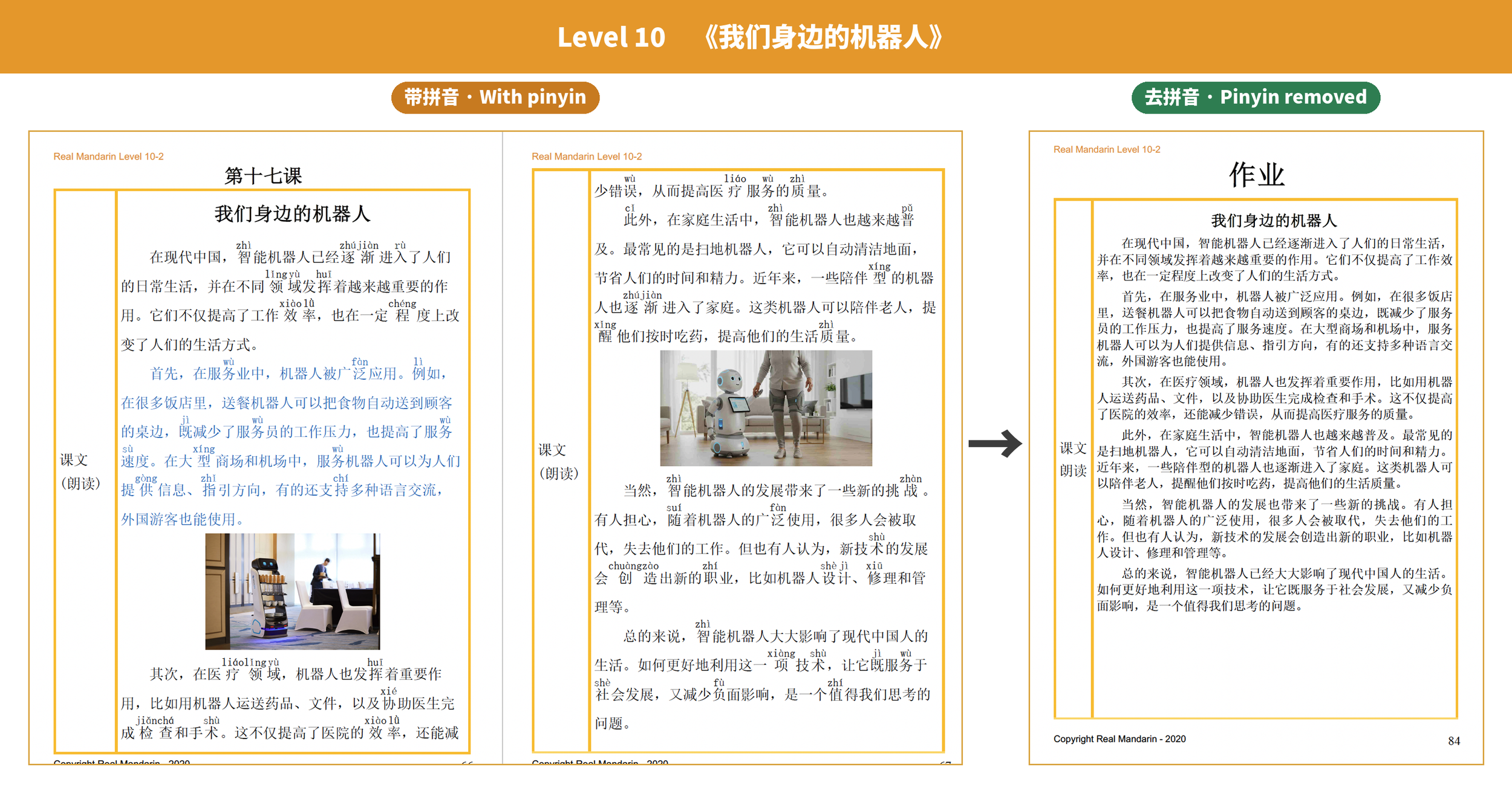
A few levels on, in a text like 我们身边的机器人, pinyin sits only over the new words (智能, intelligent; 逐渐, gradually), and the homework has none. By the Grade 8 readers, a whole page might carry only a handful.
What this means for your child
If your child still reads with pinyin, don’t panic — and don’t yank the support away. Put your energy where it counts: into vocabulary and reading. The more characters your child truly knows, the more the pinyin quietly retires on its own. Cross the river first, and the bridge comes down by itself.
Real Mandarin runs small-group Mandarin and English classes for children in Camberwell, Melbourne, aligned to the Victorian Curriculum and the VCE and IB pathways. If you’d like to find the right class for your child this term, book a free trial and pre-enrolment assessment, with no pressure.
Jingyi Jiang
Jingyi Jiang is the founder and director of Real Mandarin, a Mandarin and English tutoring school in Camberwell.