
The Peacock Princess: Why Chinese Myths Belong in an Australian Childhood
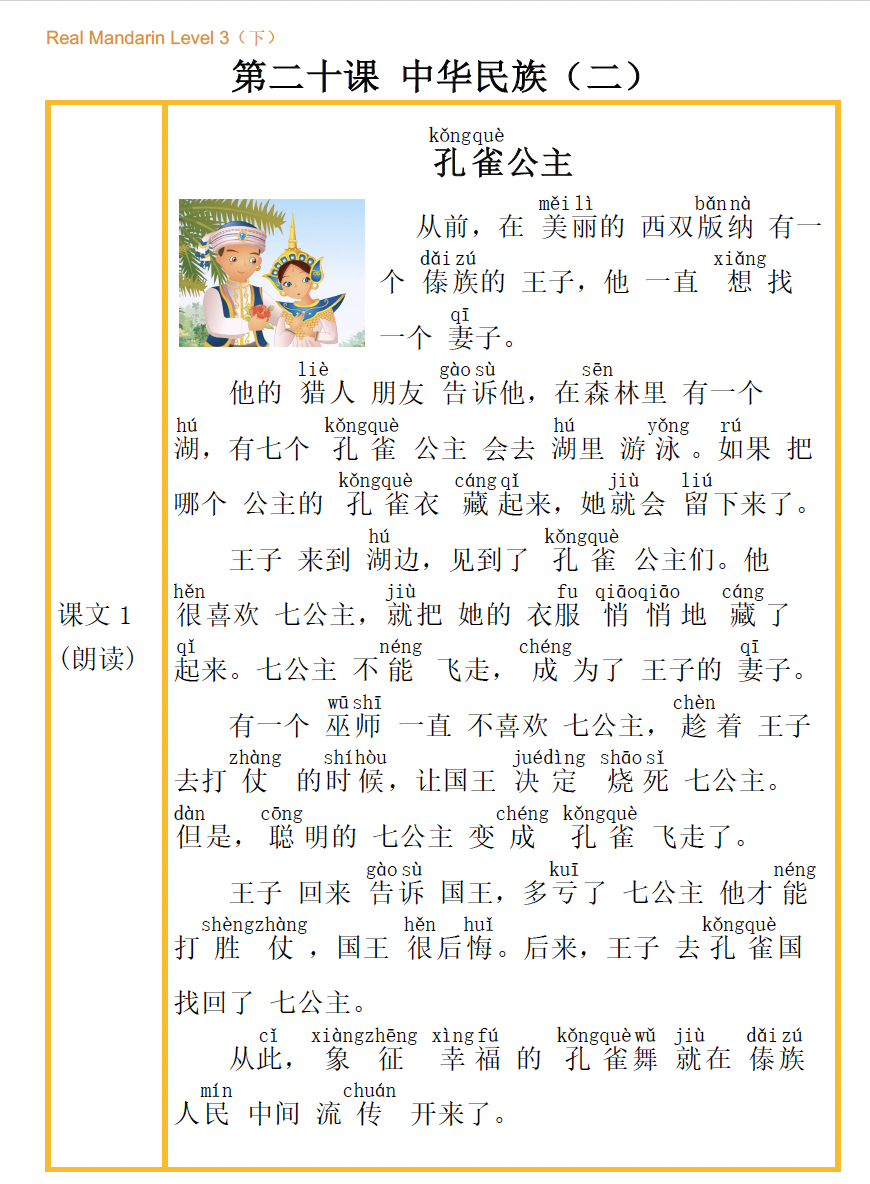
A Chinese story in the Mandarin textbook at Real Mandarin
Every culture keeps its oldest stories for a reason. Long before children can read a history book, a legend teaches them who their people are, what they value, and how the world is supposed to work. For a child growing up in Melbourne with Chinese heritage — or simply learning Mandarin because a family loves the language — these stories do something a vocabulary list never can. They give the language a home.
This term our Level 3 students met one of those stories: 孔雀公主 — the Peacock Princess. It comes from the Dai people of Xishuangbanna, in China’s far south, and it is the kind of tale that has been told aloud for centuries. Reading it in Mandarin, our students weren’t just decoding characters. They were stepping into a world their language actually comes from.
Why myths and legends matter for kids learning Mandarin here
When children learn a language far from the place it is spoken, the hardest thing to give them isn’t grammar — it’s meaning. A child in Australia can memorise that 孔雀 means “peacock” and 公主 means “princess,” but the words stay flat until they belong to something. A legend supplies that something. Suddenly 森林 (forest), 湖 (lake) and 变成 (to transform) aren’t flashcards; they’re the places and moments of a story the child wants to know the ending of.
Myths also carry a whole culture in a small package. The Peacock Princess isn’t only a romance — it’s a window into the Dai people, one of the many ethnic groups that make up 中华民族, the broader Chinese national family. Our Level 3 theme this unit is exactly that: China is not one single people but many, each with its own dress, dances and stories. For children in a multicultural city like Melbourne, that’s a wonderful thing to discover — that “Chinese culture” is itself beautifully diverse, much like the Australia they live in.
And there is a quieter benefit. Stories build reading stamina. A child will happily push through a longer passage to find out whether the prince rescues the princess — and in doing so reads far more Mandarin than any drill would ask of them, almost without noticing.
The story our class read
In beautiful Xishuangbanna, a Dai prince longs to find a wife. A hunter friend tells him a secret: seven peacock princesses come to bathe in a forest lake, and whoever hides a princess’s peacock robe can win her heart. The prince hides the robe of the seventh, youngest princess, and she stays and becomes his wife.
But a jealous sorcerer persuades the king to burn her while the prince is away at war. The clever seventh princess turns back into a peacock and flies to safety. When the prince returns and explains that it was she who helped him win the battle, the king is filled with regret — and the prince travels to the peacock kingdom to bring her home. From that day, the students read, the peacock dance has spread among the Dai people as a symbol of happiness.
It’s a story with everything a child loves — a secret, a transformation, danger, and a happy ending — and every one of those turns is a reason to read the next line.
In our classroom
Reading 孔雀公主 aloud together, our students met new words the natural way: not as a list, but as the tools they needed to follow what happens next. 藏起来 (to hide away), 变成 (to transform into), 后悔 (to regret) — words that are hard to make interesting on their own became easy to remember because they carried the plot.
We talked, too, about the Dai people and their famous peacock dance, and about how one country can hold so many different ways of dressing, dancing and telling stories. For our students, it was a small lesson in something big: that learning a language always means meeting the many kinds of people who speak it.
What this means for your child
A legend like the Peacock Princess gives your child something rare — a reason to want the next sentence in Mandarin, and a first real sense of the culture their language grows from. That combination, warmth of story and depth of culture, is what turns “learning Chinese” into loving it.
Real Mandarin runs small-group Mandarin and English classes for children in Camberwell, Melbourne, aligned to the Victorian Curriculum and the VCE and IB pathways. If you’d like to find the right class for your child this term, book a free trial and pre-enrolment assessment, with no pressure.
Jingyi Jiang
Jingyi Jiang is the founder and director of Real Mandarin, a Mandarin and English tutoring school in Camberwell.