
The One Habit That Turns a Reader Into a Writer
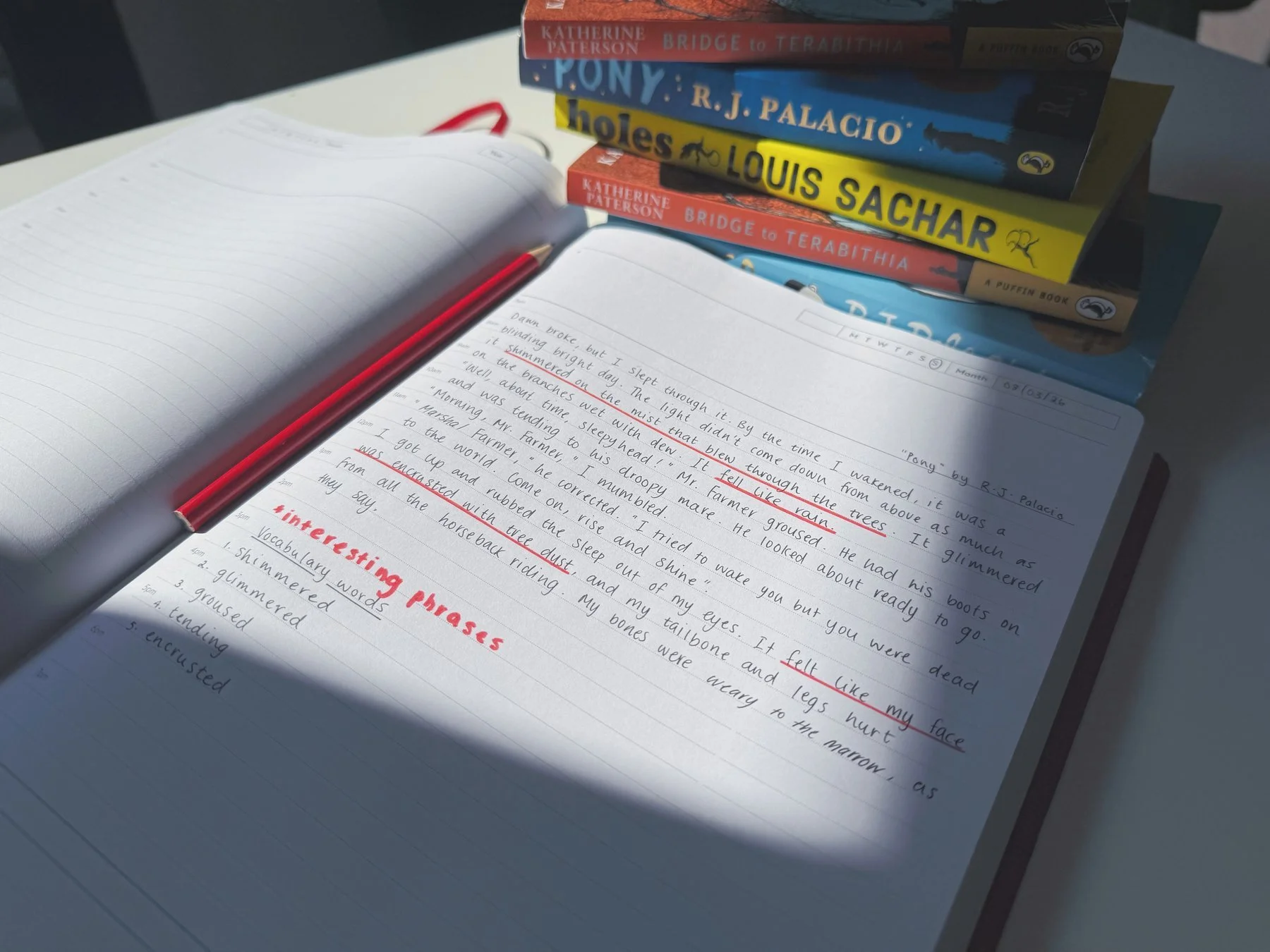
There’s a moment I look for in every child who reads a lot. They’ve finished the book, they loved it, and if you ask them what it was about, they say: “It was good.” That’s it. The whole world of the story is in there somewhere but it can’t come out yet.
Reading notes are how it comes out.
At Real Mandarin we ask students to keep 读书笔记 — reading notes — for what they read in both Chinese and English. Not book reports, not summaries to be graded. Just a small, regular place where a child writes down what they noticed. A word they’d never met. A sentence they wished they’d written. A character who did something that surprised them. It sounds almost too simple to matter. It’s the single habit I’d keep if I had to throw all the others away.
Why notes, and not just more reading
A child who only reads is a guest in someone else’s language. A child who keeps notes starts to move in. When you stop to write down why a sentence worked — the verb the author chose, the way they left something unsaid — you stop reading past the craft and start reading the craft. The book becomes a teacher instead of just a pleasure.
And the writing that comes out of notes is different from the writing that comes out of a prompt. It isn’t performed for a marker. It’s a child talking to themselves about something they actually cared about, which is where every real writer’s voice begins.
The same habit, in two languages
The reason we do this in both Mandarin and English is that it’s genuinely one skill, not two. A child who has learned to notice a precise word in an English picture book knows exactly what to look for when they read in Chinese — 一个好词, a word that lands. The habit of attention transfers even when the vocabulary doesn’t.
In English, a note might be: “‘The house creaked’. He didn’t say it was old but let the house say it.” In Chinese, the same child might write: 她把书合上,很久没有打开。The observation is the same one. Two languages, one pair of eyes learning to see.
Over a term, something quietly shifts. The notes get longer. The child starts borrowing. Either a structure from a Chinese story turns up in their English writing or an English author’s trick shows up in their 中文作文. They’re not copying. They’re building a shared toolbox, and reaching into it in whichever language they happen to be writing.
What it looks like when it’s working
You can’t rush it and you don’t grade it, which is exactly why it works. A good reading note is short. It’s specific. It’s honest. “I didn’t understand this part” is a wonderful note. Over time the child isn’t writing down what happened; they’re writing down what the author did, and the day they can name it in someone else’s book is usually the day they can start doing it in their own.
That’s the whole quiet engine of it. Read, notice, write it down. Do it in both languages, a little at a time, and you’re not building two subjects. You’re building one writer.
What this means for your child
If your child reads well but freezes when it’s time to write, or writes plenty but it comes out flat and general, reading notes are often the missing bridge. They turn reading from something a child passes through into something they gather from, in Chinese and in English at once.
It’s a habit we build with students gently, at their level, without turning it into another chore.
If you’d like to see how your child reads and writes right now — and where a small habit like this could take them — we’d love to meet them.
Jingyi Jiang is the founder and director of Real Mandarin, a Mandarin and English tutoring school in Camberwell.