
A Grade 6 student of mine came in recently with his school Mandarin results, and they were a joy to see: full marks on his speaking assessment, and 20 out of 20 on his oral presentation. His teacher’s very first comment was, “You memorised and delivered the entire presentation accurately and fluently.”
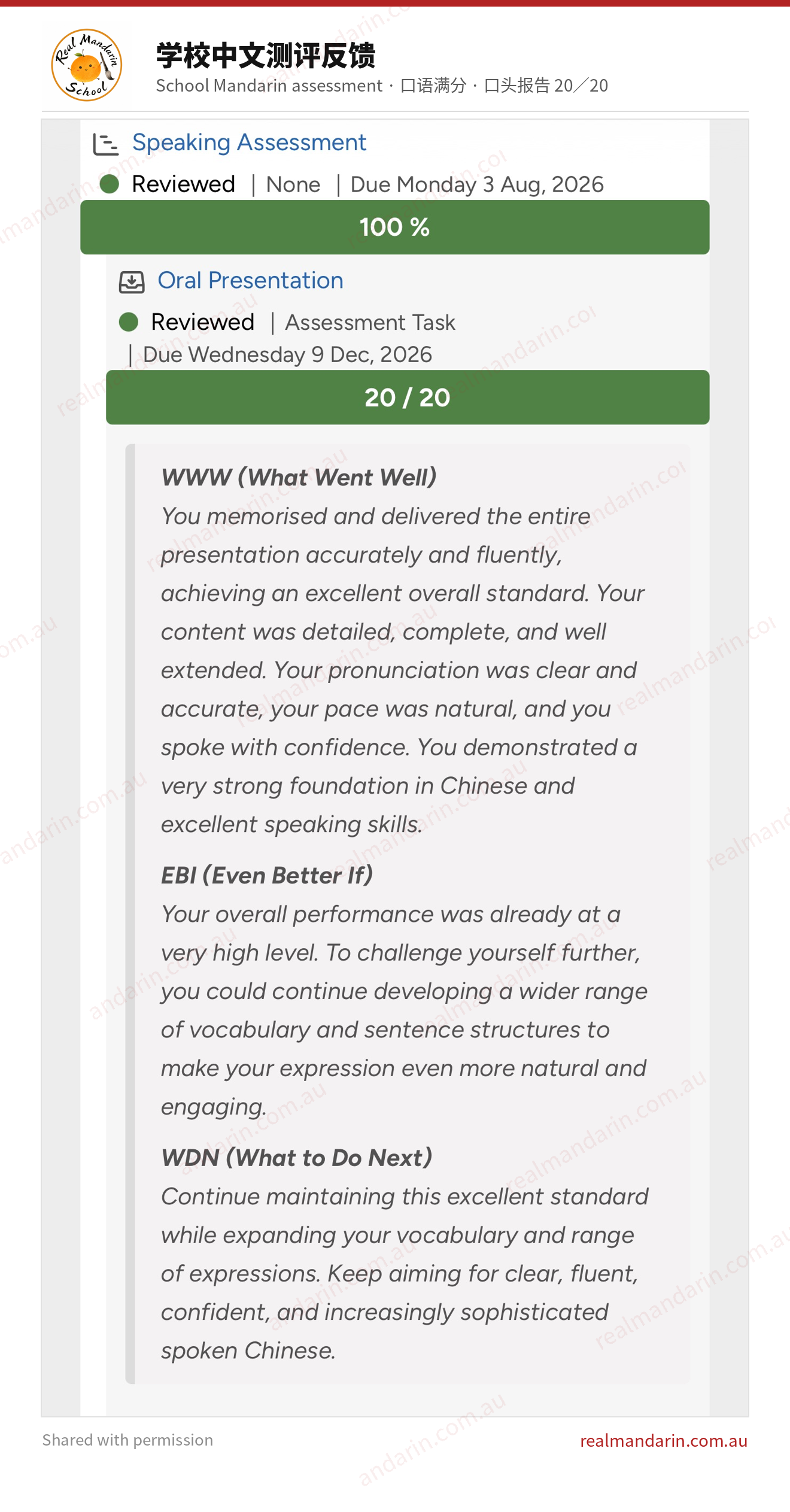
I’ve noticed that when a child does well by memorising, some parents almost apologise for it — as if the marks don’t quite count, as if “he just memorised it” were a confession. I want to gently push back on that. The ability to take in a whole text and deliver it accurately, at a natural pace, with confidence, is not a shortcut around skill. It is the skill. And like any skill, it’s trained.
Where that ability comes from
At Real Mandarin, this training starts on a child’s very first day — often when they’re only around four years old. Every week, from the beginning, our students recite their 课文 (the week’s text). It isn’t glamorous and it isn’t new; it’s the oldest way of learning a language there is. But reciting a text out loud, week after week, is how a child absorbs the rhythm, the vocabulary and the sentence patterns of Chinese — how the language gets in before we ever ask it to come back out.
From Level 2, we add a weekly 默写 (character dictation). If recitation is how the language goes in, dictation is how it stays. Hearing a word and being able to write it from memory is what turns a character a child has “seen before” into one they truly own.
None of this is dramatic. In class it’s just the ordinary weekly routine, and the children take it completely in their stride. But it is quietly building two things at once: a growing bank of language, and the memory muscle to hold and reproduce it. My student’s full marks were that muscle at work.
What his own work shows
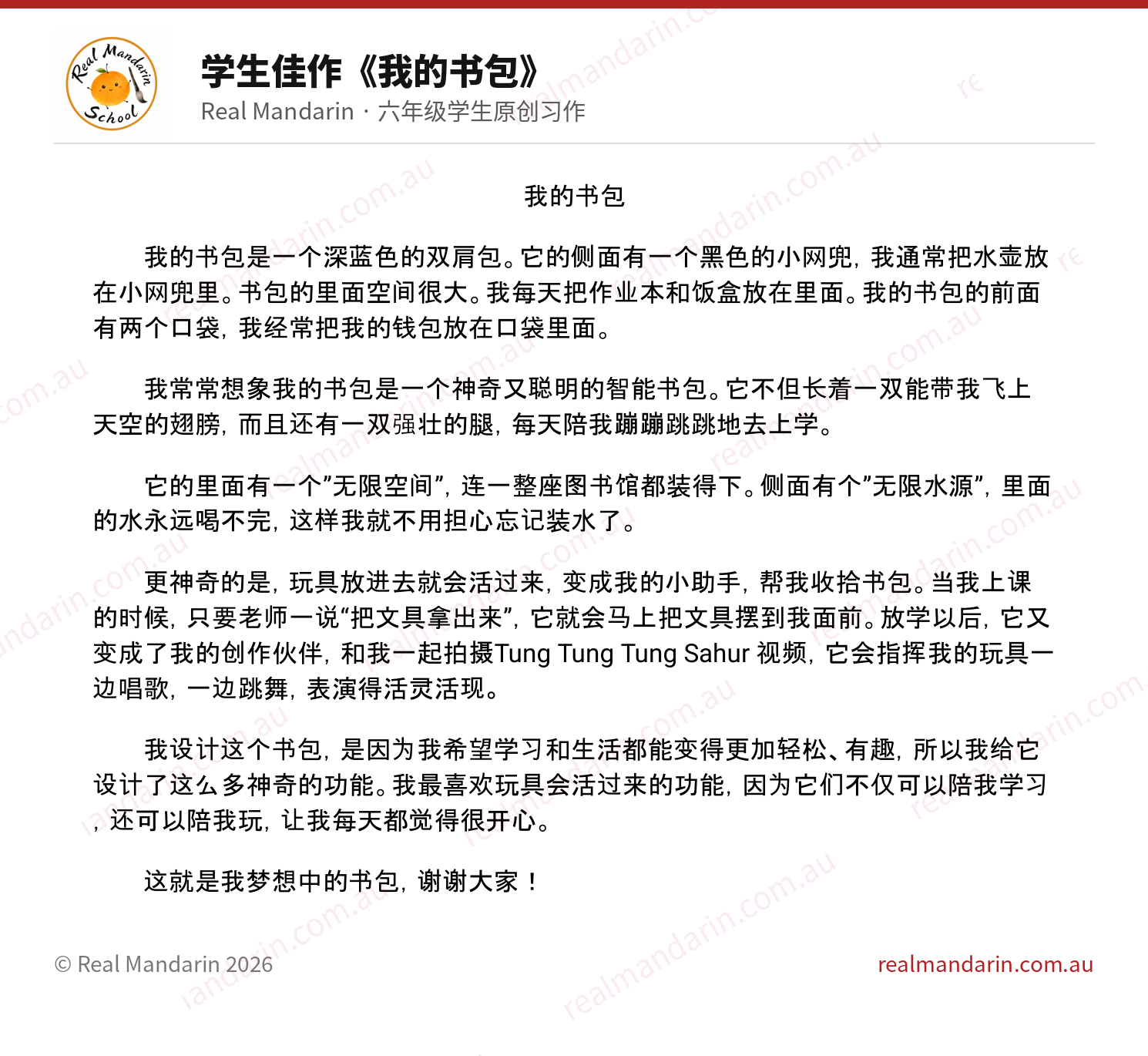
You can see the same thing in his writing. His piece, 《我的书包》 (“My Schoolbag”), imagines a magical, intelligent backpack — one with wings and strong legs to carry him to school, an “infinite space” that fits a whole library, an “endless water source” so he never forgets his drink bottle, and toys that spring to life to help him tidy up. It’s structured, it flows, and it’s full of a child’s genuine imagination. Writing like that doesn’t come from nowhere. It comes from years of texts read, recited and internalised, so that when the child sits down to create, the words are already there to reach for.
Even full marks leave room to grow
His teacher also offered one thing to build on: to keep developing a wider range of vocabulary and sentence structures, so his expression becomes even more natural and varied. I loved seeing that, because it’s exactly the road we’re already on. A deeper, more flexible language bank isn’t built in a term of last-minute cramming — it’s laid down slowly, one recited text and one dictation at a time, until a child has so much language stored that richer expression simply becomes available to them.
What this means for your child
If your child learns partly by memorising, please don’t treat it as a lesser kind of learning. Recitation and dictation have gone quietly out of fashion, dismissed as “rote,” but they remain one of the surest foundations a young language learner can have. The child who can absorb and hold language is the child who, a few years on, can use it freely. Cherish the memorising — and give it something worth memorising, every single week.
Real Mandarin runs small-group Mandarin and English classes for children in Camberwell, Melbourne, aligned to the Victorian Curriculum and the VCE and IB pathways. If you’d like to find the right class for your child this term, book a free trial and pre-enrolment assessment, with no pressure.
Jingyi Jiang
Jingyi Jiang is the founder and director of Real Mandarin, a Mandarin and English tutoring school in Camberwell.