
Let them write in pinyin first
Every so often a parent looks over their child’s Chinese writing sheets, sees a page dotted with pinyin between the characters, and asks the question I know is coming: “Shouldn’t she be writing it all in characters by now?”
It’s a fair worry, and I understand where it comes from. Many of us grew up learning to write in China, where children absorb an enormous number of characters very young, and can often set pinyin aside by around Grade 3. Held up against that memory, a page with pinyin on it can look like falling behind. But our children are learning here, in Australia, and the honest answer is that measuring them against a classroom in China sets a bar that isn’t realistic or helpful.
Here’s the thinking behind how we teach it.
Writing is really two hard jobs at once
When a child writes a story in Chinese, they are doing two genuinely difficult things at the same time: recalling how to form the characters, and composing — choosing words, building sentences, shaping an idea from beginning to end. Neither is easier than the other. If we insist that every character be written correctly from memory before a single idea goes on the page, we’ve effectively asked a young writer to carry both loads at once. What usually happens next is predictable: the child shrinks their story down to only the characters they can already write, or they lose heart and interest altogether. The writing gets smaller, safer and duller, which is the opposite of what we want.
So in the early stage, we protect the thing that’s hardest to rebuild once it’s lost: the willingness to express. We let students reach for the words they actually mean, and write them in pinyin when the character hasn’t been learned yet. The goal of a first draft is to get real ideas and full sentences down, with as rich a vocabulary as the child can command, not to prove how many characters they’ve memorised.
The first draft: ideas first
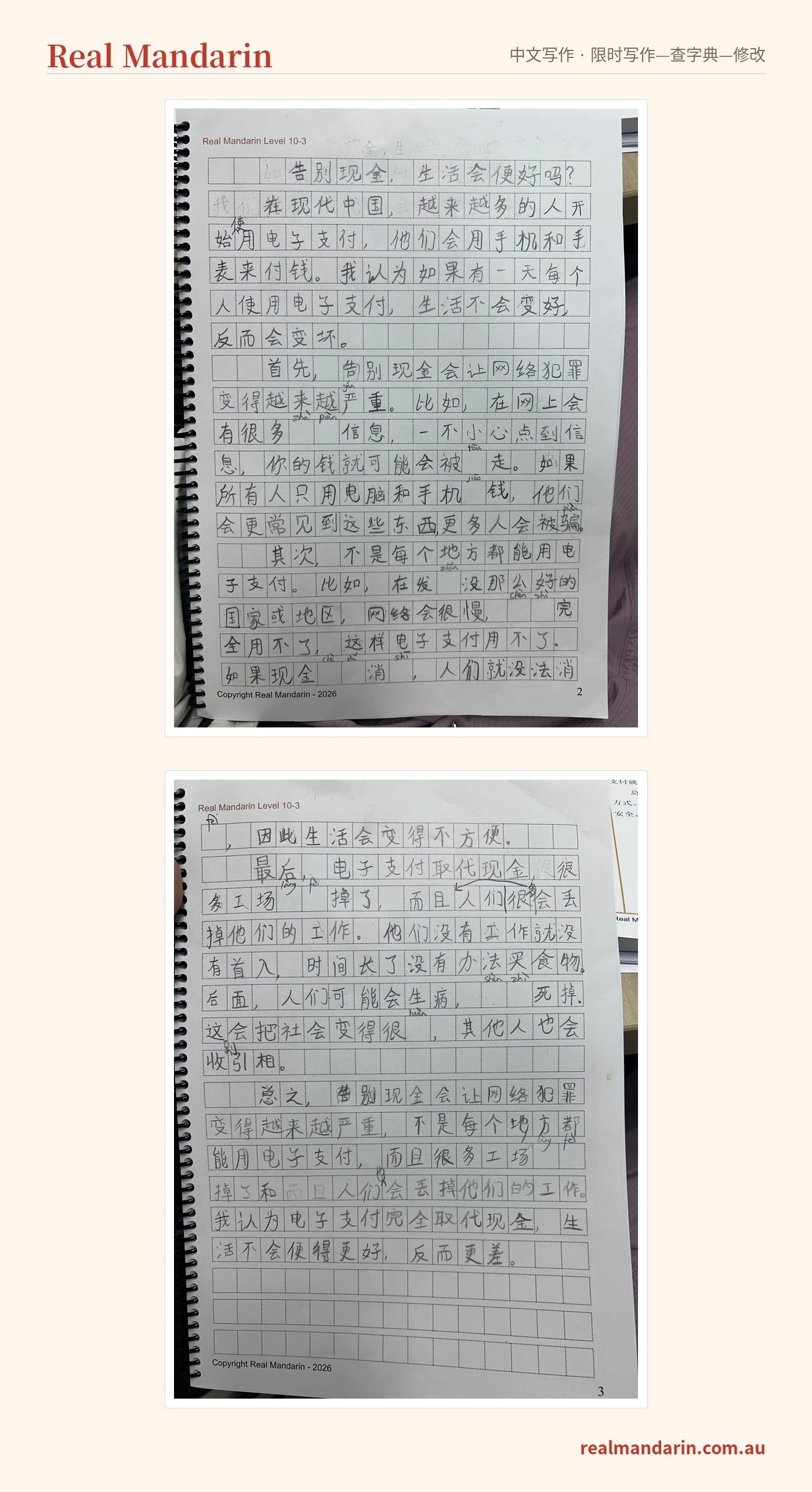
That’s what the first image shows: a student’s opening draft, pinyin and characters side by side. It looks unfinished, and that’s exactly right. What matters is that the writing is there: the sentences flow, the vocabulary is broad, the idea has a shape. The child was thinking like a writer, not rationing themselves to a handful of safe characters.
The second draft: filling in the characters
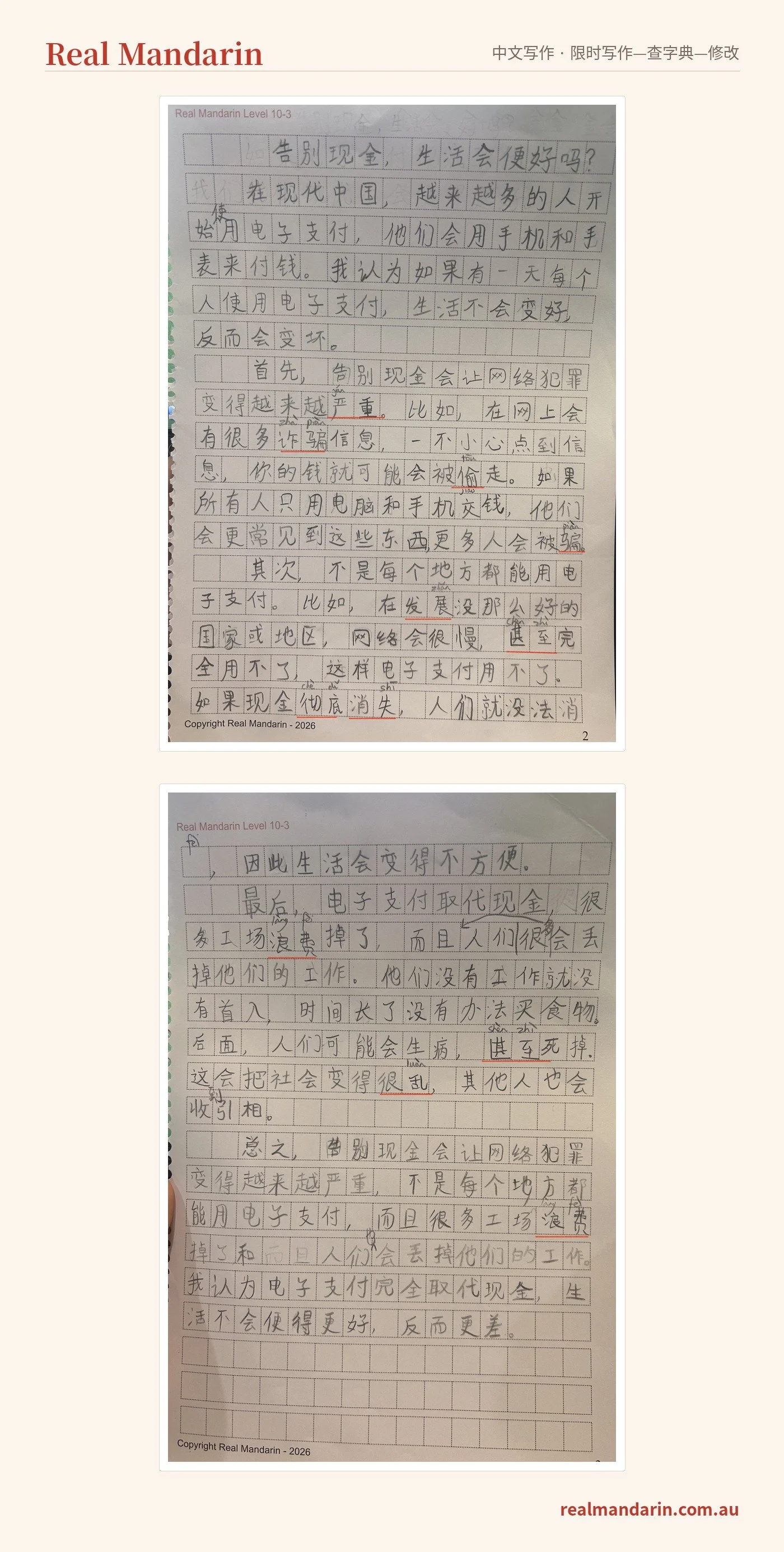
Then comes the part I love. In the second draft, the student goes back and fills in the missing characters — looking them up in the dictionary themselves. This isn’t a workaround; it’s exactly how skilled writers work, and it’s a proper procedure of advanced writing. The child learns to draft freely, then revise and self-correct. It’s worth knowing that in the VCE and IB Chinese exams, students are permitted to use a dictionary, so learning to draft, then look up and refine, is a genuinely useful habit, not a crutch.
Characters absolutely still matter, and they keep coming. Here, many students go on learning new characters right through secondary school, and by the time they sit VCE or IB they’ve mastered plenty. But we don’t wait until then to build writing skill, interest and confidence. Those grow from the very first story a child dares to tell — and pinyin is simply the scaffolding that lets them tell it.
What this means for your child
If your child’s Chinese writing has pinyin in it, that’s not a step backwards. It usually means they’re reaching for ideas bigger than their current character list, which is exactly what a developing writer should do. The characters will follow, draft by draft.
If you’d like to talk through how your child is learning Mandarin, or how to help their Chinese writing grow, we’re always happy to sit down with you. Get in touch to arrange an information session — no pressure, just a conversation about your child.