
Every term, a parent hands me a page and a half of their child’s writing and asks, hopefully, “It’s a lot — is it good?” Length is the first thing we notice, so it’s the first thing we reach for. After years of teaching English writing, here is the honest answer: how much a child writes tells you very little. What matters is how much each sentence is doing.
Strong writing is compact, precise and deliberately structured. A good piece isn’t a small event narrated at great length — “and then, and then, and then.” It’s a writer making choices, and fitting as many of them as possible into a tight space: an opening that pulls you in, detail instead of vague summary, exact word choices, a rhythm of long and short sentences, a shape with a real beginning, middle and end. Writing is a toolkit. The skill is knowing the tools exist — and using as many as the moment allows.
That’s easier to show than to explain, so here are two of our students’ pieces with the techniques marked.
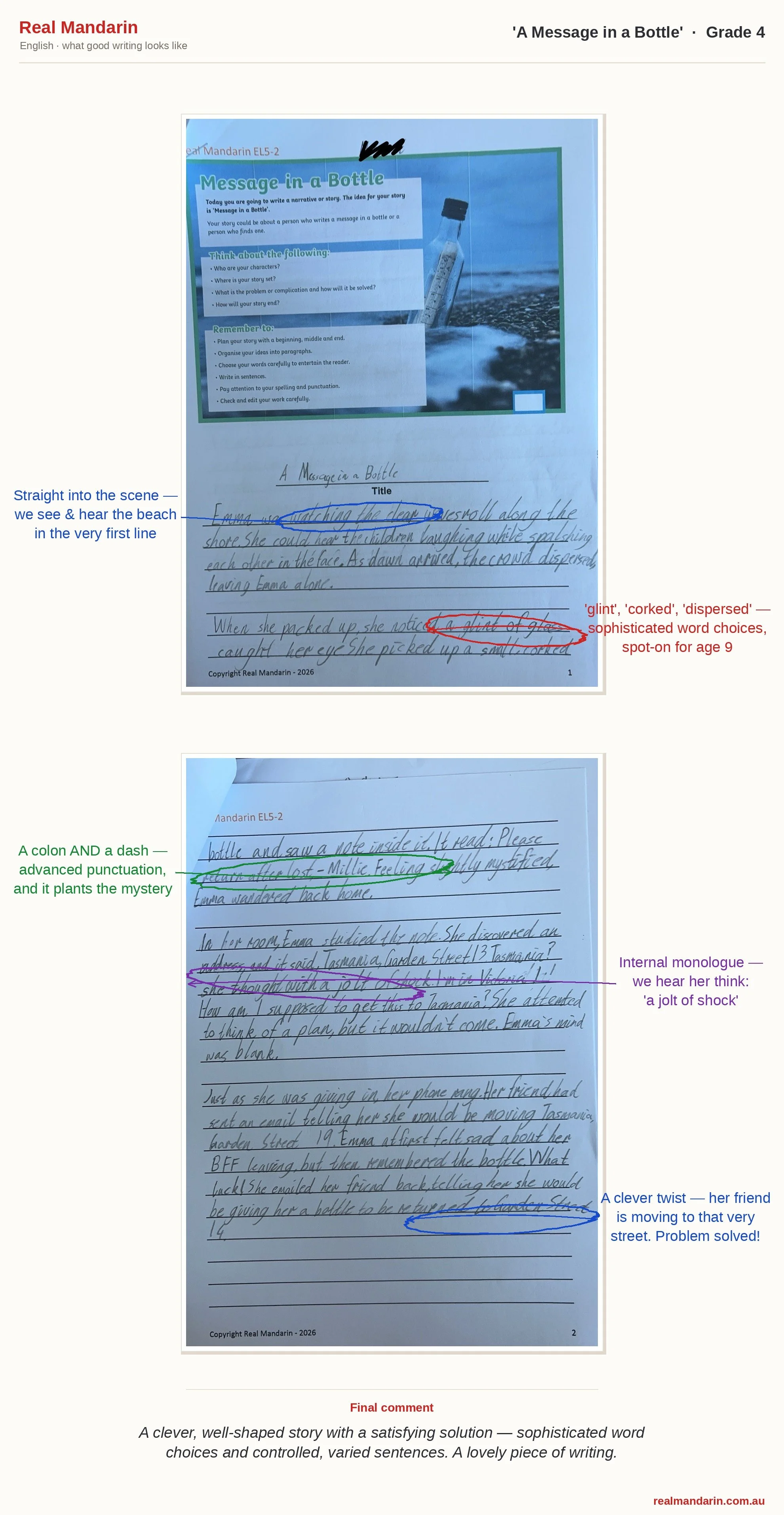
Grade 4: “A Message in a Bottle”
A Grade 4 student opens not with a warm-up but with the scene itself: “Emma was watching the clear waves roll along the shore.” We arrive through sight and sound at once. She writes “a glint of glass” — a precise noun with a touch of alliteration, chosen over a plain “a bottle.” A found note plants a question the reader now has to follow; an interstate address raises a clear, concrete complication; and the ending loops back to the beginning so nothing is wasted. It isn’t long. Every sentence earns its place.
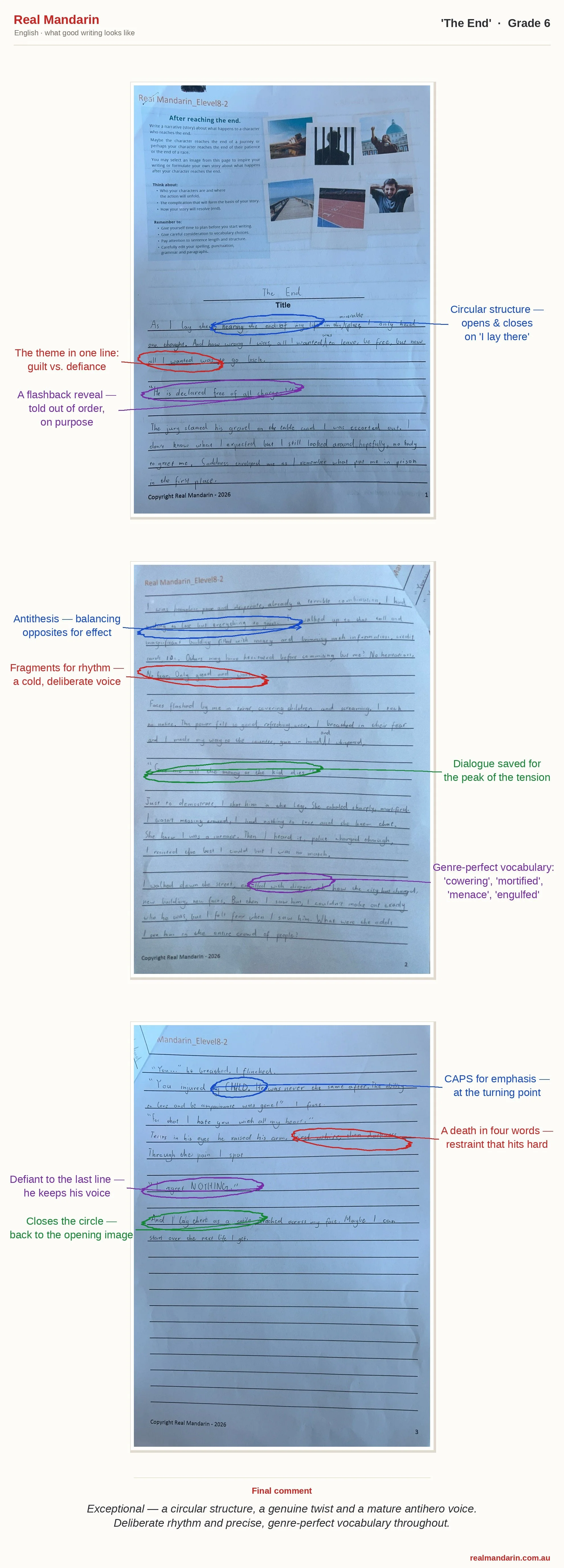
Grade 6: “The End”
A Grade 6 student takes on something much harder — a morally complex narrator, told out of order. The story opens at its own ending (a frame), jumps back in time, and trusts the reader to keep up. There’s real rhetorical control: “I had nothing to lose but everything to gain” balances one idea against its opposite; a rhetorical question is answered by three clipped fragments, so the rhythm itself sounds cold. Capital letters land on exactly two charged words. A death is rendered in four: “First white, then darkness.” Then the final line returns to the first, closing the circle. It’s a mature, dramatic piece — and technically, it is doing a great deal at once.
What this means for your child
Neither student got there by being told to “write more” or “use bigger words.” They got there by learning, explicitly, what the tools are and when to reach for each one — then practising until the choices became instinct. That is what our English writing classes teach: not volume, but craft.
If you’d like to know where your child’s writing sits right now, we offer a free, no-pressure assessment. Your child writes, meets a teacher, and you get honest, specific feedback on what they already do well and the next tool to add.