
The Day Our Class Discovered “睡觉” — What Dialects Taught Us About Belonging
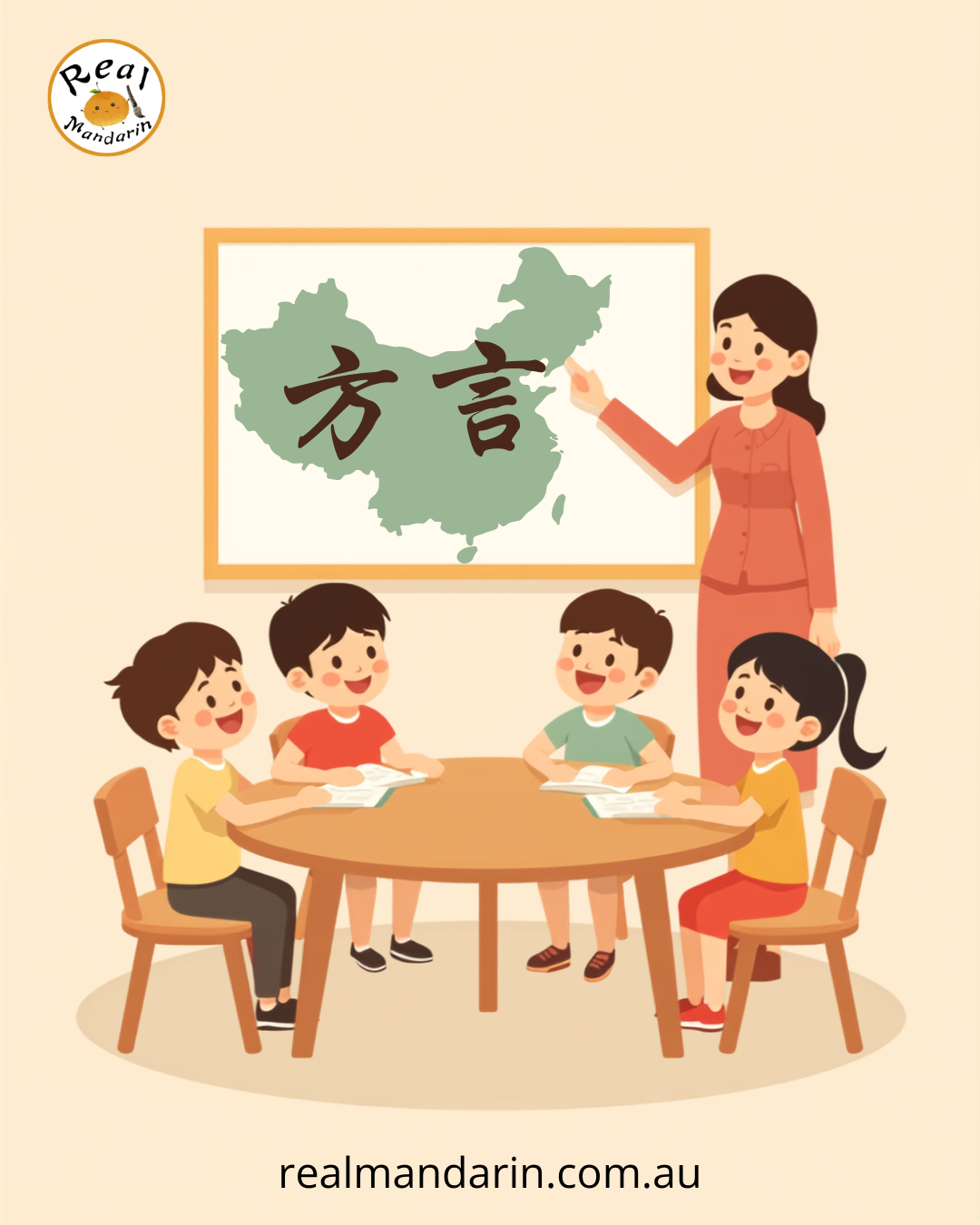
Some of the best moments in a Mandarin class aren’t in the lesson plan.
This week, a class of ours drifted off-topic in the loveliest way. We’d started on something else entirely, but the conversation wandered toward where everyone’s family was from. Once it did, there was no steering it back.
One student mentioned that his mum grew up in Shanghai. Another said her grandmother speaks the dialect of Wuxi. And then came the discovery that lit up the whole room: in Shanghainese and in the Wuxi dialect, the word for “to sleep” — 睡觉 — sounds almost exactly the same. The children were delighted. Soon they were trading more examples: words that sound identical across dialects but mean completely different things, sounds that shift the moment you cross from one town to the next.
That kind of energy is very hard to teach. It has to be discovered.
“Chinese background” is not one thing
We often talk, loosely, about children who have “a Chinese background.” It’s a convenient phrase. But sit down and actually listen to a group of them, and you realise how much that phrase quietly flattens.
Every family carries a different route home. Shanghai, Wuxi, Guangdong, Sichuan — different accents, different flavours at the dinner table, a different tune a grandmother hums when she’s rocking a child to sleep. What we call “Chinese background” was never a single, uniform template. It’s more like a forest: each family growing along its own line, yet standing within sight of the others.
For children growing up in Melbourne, this matters more than it might seem. They already live between languages and places. When they realise their own family’s version of Chineseness is specific — that it has a name, a sound, a hometown — it stops being a vague inheritance and becomes something that is genuinely theirs.
Why this makes children want to learn
Here’s the part that surprised even us: once the children saw that these differences were real, and that they were noticed and valued, their motivation to learn Mandarin grew rather than shrank.
That makes sense when you think about it. Learning suddenly wasn’t just “studying a language.” It was claiming a root. Standard Mandarin became the shared thread that lets them talk to one another — and to a wider world — while their family’s dialect remained the private, particular thing worth holding on to. The two don’t compete. One opens doors outward; the other keeps a door open home.
We don’t teach dialects, and we’re not trying to. What we do is create a room where a child can say “my grandmother speaks Wuxi hua” and have that be interesting, valued, and worth exploring, and where standard Mandarin is the bridge that connects all of these different homes.
What we hope to pass on
The goal was never to hand children a single, standardised version of Chinese to memorise. It’s to help each child grow their own version — fluent in the standard sound that connects them to millions of others, and still able to hear, and cherish, the particular accent that connects them to their own family.
Understand the standard, remember the hometown. Speak Mandarin confidently, and keep that one note of home.
Dialects aren’t something to grow out of. They’re roots.
What this means for your child
Every child’s Chinese is a little different, and that’s exactly as it should be. When we make room for where each family comes from, children learn Mandarin not as a chore but as a way of carrying their own story forward.
Real Mandarin runs small-group Mandarin and English classes for children in Camberwell, Melbourne, aligned to the Victorian Curriculum and the VCE and IB pathways. If you’d like to find the right class for your child this term, book a free trial and pre-enrolment assessment, with no pressure.
Jingyi Jiang
Jingyi Jiang is the founder and director of Real Mandarin, a Mandarin and English tutoring school in Camberwell.